Danh mục
How to Reduce Film Waste During Mattress Packing Operations |NAIGU
Discover practical ways to reduce film waste in mattress packing, improve cutting accuracy, optimize film specifications, and increase packing efficiency with suitable machinery and materials.
Nov 10th,2026
5 Lượt xem
Film waste is a common challenge in mattress manufacturing and packing operations. Excessive film consumption increases material costs, creates unnecessary production waste, and affects overall packing efficiency. For mattress factories handling different sizes, thicknesses, and packing formats, improving film utilization can bring measurable cost savings without compromising package quality.
Reducing film waste does not simply mean using less material. It requires the right film specifications, accurate cutting, stable machine operation, and standardized packing procedures.
1. Select the Correct Film Width and Thickness
Using oversized or unnecessarily thick film is one of the most common reasons for excessive material consumption.
Before purchasing mattress packing film, manufacturers should evaluate:
-
Mattress width, length, and thickness
-
Packing format, such as flat packing or roll packing
-
Required film overlap and sealing allowance
-
Compression ratio and final package dimensions
-
Film strength and puncture resistance
For example, a mattress with greater thickness may require wider film or a different packing structure. Selecting film based only on mattress width can result in insufficient coverage or excessive material usage.
The goal is to match film dimensions and thickness to the actual packing requirements.
2. Standardize Mattress Packing Specifications
Factories often produce multiple mattress models with different dimensions. Without standardized packing specifications, operators may use inconsistent film lengths and cutting allowances.
A practical solution is to establish film consumption standards for different mattress categories.
These standards can include:
-
-
-
-
-
Target package dimensions
With clear specifications, operators can reduce unnecessary adjustments and avoid cutting excessive film during production.
3. Improve Cutting Accuracy
Inaccurate film cutting can create significant material waste, especially in high-volume mattress factories.
Common causes include incorrect length settings, inconsistent manual measurements, unstable film feeding, and repeated cutting adjustments.
To improve cutting accuracy:
-
Use calibrated cutting systems.
-
Set cutting parameters according to mattress dimensions.
-
Check cutting consistency during production.
-
Replace or maintain worn cutting components.
-
Minimize unnecessary trial cuts.
Automatic cutting systems can help maintain consistent film lengths and reduce operator-dependent variations when properly adjusted.
4. Maintain Stable Film Feeding and Tension
Unstable film feeding can cause wrinkles, uneven film distribution, and incorrect positioning. These problems may lead to rejected packages and additional film consumption.
Film feeding performance depends on several factors, including roll installation, tension settings, roller condition, and film characteristics.
Manufacturers should regularly check:
-
-
-
-
Film tracking during operation
-
Smoothness of the feeding and unwinding process
For compression roll packing lines, stable film feeding is particularly important because the film must remain properly positioned throughout the packing process.
5. Choose Film with Suitable Mechanical Properties
Film quality directly affects material utilization.
Film that is too weak may tear during compression or transportation, resulting in repacking and additional consumption. On the other hand, unnecessarily high film thickness may increase material costs without providing meaningful performance benefits.
When evaluating mattress packing film, consider:
Tensile strength: Helps the film withstand pulling forces during packing.
Puncture resistance: Reduces the risk of damage from mattress edges and handling.
Elongation: Supports the film's ability to stretch under suitable packing conditions.
Sealing performance: Helps maintain package integrity after sealing.
The appropriate film specification should be determined through actual machine trials and finished-package testing rather than thickness alone.
6. Reduce Repacking and Packaging Defects
Film waste is not limited to excess material left after cutting. Damaged or poorly sealed packages can also increase consumption.
Common problems include:
-
Film tearing during compression
-
-
Wrinkled or uneven packages
-
Incorrect film positioning
-
Package damage during handling
A consistent quality inspection process helps identify problems early. Checking the first few packages after machine adjustments and conducting regular inspections during production can reduce repeated packing.
7. Match Packing Equipment to Production Requirements
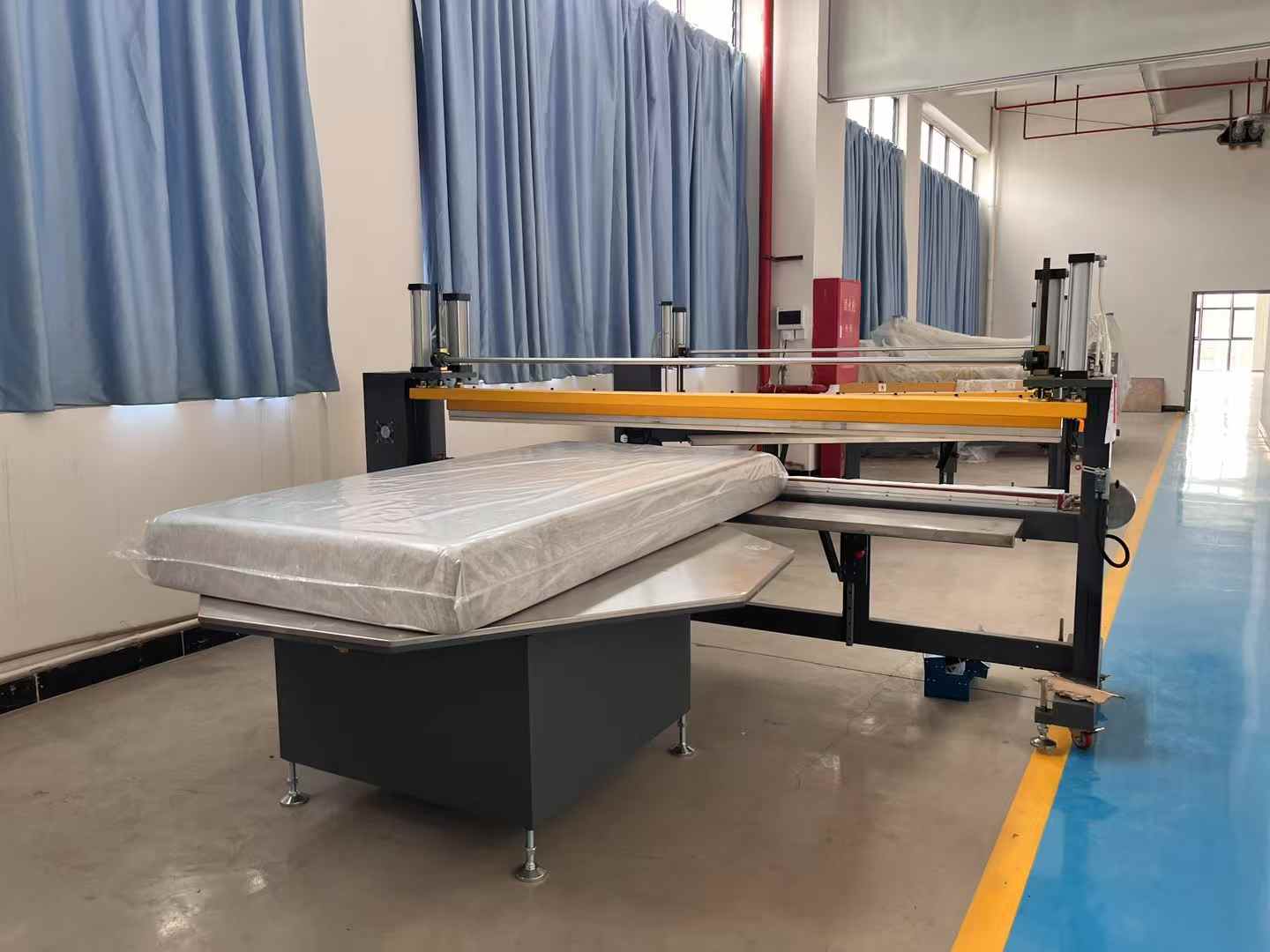
Different mattress factories have different production volumes and packing requirements. The right equipment can improve film utilization by making feeding, cutting, sealing, and compression more consistent.
Common equipment options include:
-
Mattress compression machines: Compress mattresses before final packing and help standardize package dimensions.
-
Mattress roll packing machines: Combine compression and rolling to produce compact packages.
-
Automatic mattress packing lines: Integrate multiple packing processes to improve production consistency.
-
Film feeding and cutting systems: Help control film positioning and cutting length.
When selecting equipment, manufacturers should consider mattress specifications, production capacity, packing format, and compatible film materials.
8. Monitor Film Consumption per Mattress
Measuring film consumption is essential for identifying waste and evaluating improvements.
A simple approach is to record the total film used and the number of qualified mattresses packed during a production period.
Film consumption per mattress:
\[ \text{Film Consumption} = \frac{\text{Total Film Used (kg)}}{\text{Number of Qualified Mattresses}} \]
For example, if a factory uses 500 kg of film to pack 1,000 mattresses, the average consumption is 0.5 kg per mattress.
Factories can compare this figure across different mattress models, packing machines, and production shifts to identify opportunities for improvement.
Conclusion
Reducing film waste during mattress packing operations requires a combination of accurate film selection, standardized specifications, stable feeding, precise cutting, and reliable packing equipment.
For mattress manufacturers, the most effective approach is to evaluate the entire packing process rather than focusing on film thickness or purchasing price alone. Better coordination between film materials and packing machinery can reduce unnecessary consumption, improve package consistency, and support more cost-efficient production.
NAIGU provides mattress packing machinery and PE film solutions for mattress manufacturers. From compression and roll packing equipment to suitable packing materials, manufacturers can explore integrated solutions based on their production requirements.
Contact NAIGU to discuss your mattress packing requirements and find a suitable film and machinery solution.


